

Free Sales Ending Soon - Use Real NCA-6.10 PDF Questions [Sep 03, 2025]
Updated Sep-2025 Exam NCA-6.10 Dumps - Pass Your Certification Exam
NEW QUESTION # 32
An administrator is conducting updates in a Nutanix cluster and is being prompted for handling non-migratable VMs.
Which VM type is non-migratable?
- A. Memory Overcommitted
- B. VMs without NGT
- C. VMs marked as an Agent
- D. VMs O VMs with attached Volume Groups
Answer: D
NEW QUESTION # 33
What is the benefit of configuring user-defined Alert Policies in Prism Central?
- A. It automates VM migrations.
- B. It restricts network access for administrators.
- C. It customizes alert thresholds.
- D. It reduces the frequency of system updates.
Answer: C
Explanation:
The correct answer isA. It customizes alert thresholds.
User-defined Alert PoliciesinPrism Centralallow administrators to definecustom alert conditionsand thresholdstailored to specific workload behaviors and operational requirements. This helps fine-tune monitoring by settingalert criteria for metrics such as CPU usage, memory utilization, IOPS, latency, etc., beyond the default system-generated alerts.
Key Capabilities Include:
* Define conditions usingpredefined metrics.
* Set thresholds andseverity levels.
* Associate alerts withspecific entitieslike VMs, hosts, or clusters.
* Integrate withemail, SNMP, or third-party tools.
Prism Central UI Navigation Path:
Alerts & Monitoring > Alert Policies > Create Alert Policy
Official Reference:
* Nutanix Administration Guide - Alerts and Monitoring
* Excerpt: "User-defined alert policies in Prism Central allow administrators to define custom thresholds for system metrics, enabling more granular and proactive monitoring."
* Nutanix Prism Central Guide - Alert Policies Section
Conclusion:Custom alert policies donotautomate VM migrations (C), limit access (B), or control update frequency (D). Only optionAreflects the actual function.
NEW QUESTION # 34
Which Nutanix Support case priority level indicates that the system is available but experiencing issues that directly impact productivity?
- A. P4
- B. P3
- C. P1
- D. P2
Answer: D
Explanation:
Nutanix Support case priority levels are defined as follows:
* P1 (Critical):The system is down or severely impacted, requiring immediate attention.
* P2 (High):The system is available but experiencing issues that directly impact productivity or operations.
* P3 (Medium):The system is functioning, but there are non-critical issues or questions.
* P4 (Low):General questions or requests that do not impact system performance.
The scenario described matchesP2, where the system is available but productivity is directly affected by the issue.
References:
Nutanix Support Policy Documentation.
Nutanix Knowledge Base Article on Support Case Priorities.
NEW QUESTION # 35 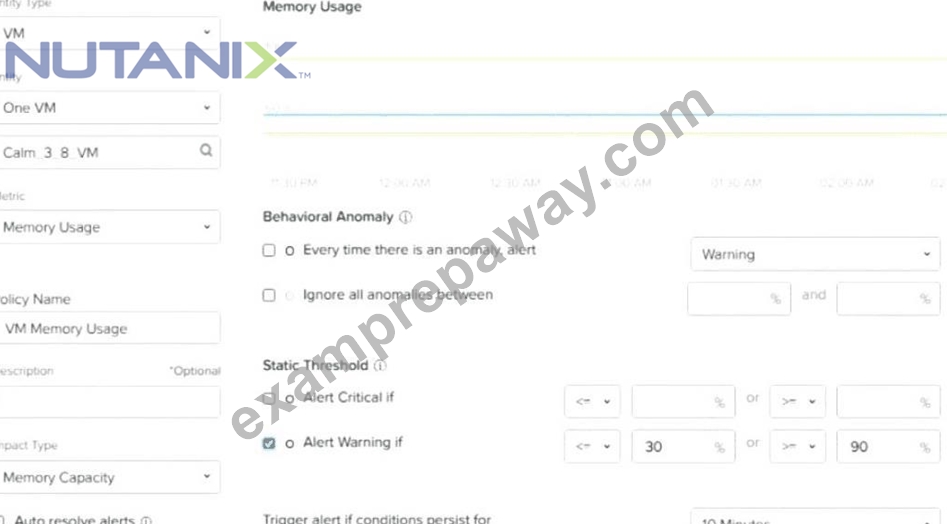
A custom alert policy is configured for a VM named Calm_3_8_VM to generate aWarningalert ifmemory usageexceeds90%or is below30%for10 minutes.
What action can be taken to prevent this alert policy from creating multiple alerts within a 48-hour period if the 90% threshold is crossed multiple times?
- A. After alert occurs, uncheck Enable Policy box for 48 hours.
- B. Set Ignore all anomalies between to 90% and 100%.
- C. Select highest value in Trigger alert if conditions persist for.
- D. Select the Auto resolve alerts checkbox and click Save.
Answer: D
Explanation:
The correct answer isA. Select the Auto resolve alerts checkbox and click Save.
When an alert policy is configured based on astatic threshold, it will generate an alert each time the condition is met unless it has beenauto-resolvedor manually acknowledged. By enablingAuto resolve alerts, the system willautomatically clear the alertonce the metric falls back within the acceptable range. This preventsduplicate alertswhen the threshold is exceeded repeatedly within a short timeframe (e.g., multiple times over 48 hours).
Explanation of Incorrect Options:
* B (Disable policy):Not scalable or operationally sound.
* C (Ignore anomalies):Applies only to behavioral anomalies, not static thresholds.
* D (Trigger duration):Increases delay before alerting but does not suppress repeated alerts.
UI Location in Image:
#"Auto resolve alerts" is visible just below "Impact Type."
Official Reference:
* Nutanix Prism Central Guide - Alert Policies
* Excerpt: "Enable 'Auto resolve alerts' to ensure alerts are cleared automatically once conditions normalize, avoiding duplicate alerts."
NEW QUESTION # 36
An administrator needs to configure a solution that ensures VMs automatically power on in a specific order at the DR site in the event of a disaster.
Which feature will achieve this?
- A. Category
- B. Resource Scheduling
- C. Recovery Plan
- D. Protection Policy
Answer: C
Explanation:
The feature that ensures VMs automatically power on in a specific order at the DR site during a disaster is a Recovery Plan. Recovery Plans are part of Nutanix's DR functionality and allow administrators to define startup sequences, dependencies, and priorities for VMs during failover scenarios.
Steps:
* Create a Recovery Plan in Prism Central under the DR section.
* Configure the VM power-on sequence and dependency rules.
* Test the Recovery Plan to ensure it operates as intended.
References:
Nutanix Disaster Recovery Guide - Recovery Plan Configuration.
Nutanix Prism Central Documentation - DR Features.
NEW QUESTION # 37
An administrator wants to apply tags to licenses to simplify future renewals.
What interface would be used to complete this operation?
- A. Clusters in the Support Portal
- B. Prism Central Licensing
- C. License Inventory in the Support Portal
- D. Prism Element Licensing
Answer: B
Explanation:
Applying tags to licenses to streamline future renewals is a task that can be completed inPrism Central Licensing. Prism Central provides centralized license management for clusters, enabling administrators to apply and manage license tags, which simplifies tracking and renewal tasks across multiple clusters. Here's how it works:
* Prism Central Licensing Overview:Prism Central includes a dedicated licensing interface that provides a consolidated view of all licenses associated with your clusters. From this interface, administrators can categorize licenses using tags such as "Renewal-2025" or "Production," making it easier to identify and manage renewals or assignments.
* Steps to Apply Tags in Prism Central:
* Navigate toPrism Central > Settings > Licensing.
* Select the desired license(s) from the list.
* Use the "Tags" option to create or apply predefined tags to categorize these licenses.
* Why Not Other Options?:
* A. Clusters in the Support Portal: The Support Portal is primarily used for support-related tasks, such as managing cases or accessing documentation, and does not include license tagging capabilities.
* B. License Inventory in the Support Portal: While the Support Portal allows you to view license inventory, it does not support operational tasks like tagging.
* D. Prism Element Licensing: Prism Element is focused on managing licensing for individual clusters and lacks the centralized management and tagging functionality available in Prism Central.
:
Nutanix Prism Central Guide - Refer to the Licensing section in the official guide for detailed instructions.
Nutanix Licensing Overview - Explains Prism Central licensing features.
Nutanix University Certification Blueprints - Licensing topics often covered in relevant Nutanix certification courses.
NEW QUESTION # 38
When configuring dual encryption, which key management method is supported?
- A. External Key Manager
- B. Native Key Manager
- C. Lockdown Mode Enabled
- D. Trusted Platform Module
Answer: A
Explanation:
When configuring dual encryption in Nutanix, anExternal Key Manager(EKM) is required. This allows the cluster to use an external hardware-based or software-based key management system to securely store and manage encryption keys. The combination of external and native encryption ensures compliance with high security standards.
* A. Trusted Platform Module:Incorrect, as TPM is not used for managing dual encryption keys.
* B. External Key Manager:Correct, as dual encryption relies on an external system to manage keys.
* C. Native Key Manager:Incorrect, as native key management alone does not support dual encryption.
* D. Lockdown Mode Enabled:Incorrect, as Lockdown Mode relates to cluster security, not encryption key management.
References:
Nutanix Data-at-Rest Encryption Guide.
Nutanix Support Documentation on Dual Encryption and Key Management.
NEW QUESTION # 39
Which storage container option reduces the available storage to other containers?
- A. Capacity Deduplication
- B. Reserved Capacity
- C. Erasure Coding
- D. Advertised Capacity
Answer: B
NEW QUESTION # 40
When creating a new storage container, what is the default configuration for Compression?
- A. Post-process (60 minutes)
- B. Inline
- C. Post-process (15 minutes)
- D. Disabled
Answer: D
Explanation:
The correct answer isB. Disabled.
When creating a new storage container in Prism Element or Prism Central,compression is disabled by default. The administrator mustexplicitly enableone of the available compression options:
* Inline Compression
* Post-process Compression
If no compression type is selected, the container remains uncompressed.
UI Navigation Path:
Storage > Storage Containers > Create Container > Compression Settings
Clarifications:
* A (60 mins)andC (15 mins): Not standard default post-process intervals.
* D (Inline): Must be manually selected.
Official Reference:
* Nutanix Storage Administration Guide - Creating and Configuring Containers
* Excerpt: "Compression is disabled by default during container creation. Admins must select inline or post-process if desired."
NEW QUESTION # 41
At an edge installation with only 1GbE uplinks, which interface configuration should be used?
- A. No Uplink Bond
- B. Round Robin
- C. Active/Backup
- D. Balance-SLB
Answer: C
Explanation:
The correct answer isB. Active/Backup.
Foredge environmentswith limited uplink capacity, such as1GbE, the recommended bond mode isActive
/Backupdue to the following reasons:
* Providesredundancywithout requiring link aggregation support from the upstream switch.
* Avoids complexity and performance imbalance that can occur with hashing algorithms in other modes (e.g., Balance-SLB).
* Round RobinandBalance-SLBcan causepacket reordering, performance issues, and are not ideal for low-throughput links.
Prism Element Configuration Path:
Network Configuration > Host NIC Bonding Mode
Official Reference:
* Nutanix Network Best Practices Guide - Edge Deployment Section
* Excerpt: "For clusters using 1GbE uplinks, Active/Backup bond mode is recommended for high availability without complexity."
NEW QUESTION # 42
How can an administrator work with Nutanix Support to recover a deleted VM, in its most up-to-date status, within a 24-hour period of the VM being deleted?
- A. Use NC2 on AWS.
- B. Use the Recycle Bin.
- C. Use third party tools.
- D. Use Nutanix Recovery Plan.
Answer: B
Explanation:
The correct answer isB. Use the Recycle Bin.
TheRecycle Binfeature in Nutanix enablessoft deletion of VMs, where the deleted VM is retained in a non- visible state for24 hoursby default before being purged. During this retention window:
* NutanixSupportcan assist in recovering the VM in itsmost up-to-date state.
* No snapshots or backups are required for this recovery mechanism.
* TheRecycle Bin is enabled by defaultin recent AOS versions.
UI Path (for visibility):
This functionality is internal and requires Support engagement for recovery.
Clarification:
* A (Nutanix Recovery Plan):Used with NearSync or Async DR; does not recover recently deleted VMs automatically.
* C (NC2 on AWS):Disaster recovery infrastructure, not applicable to local deleted VM recovery.
* D (Third-party tools):Irrelevant to Nutanix native functionality.
Official Reference:
* Nutanix Administration Guide - VM Recovery using Recycle Bin
* Excerpt: "Deleted VMs can be recovered by Nutanix Support within 24 hours using the Recycle Bin soft-delete capability."
NEW QUESTION # 43
Which storage protocol is supported for a datastore when using ESXi as the hypervisor within a Nutanix cluster?
- A. LVM
- B. NFS
- C. SMB
- D. iSCSI
Answer: B
Explanation:
When using ESXi as the hypervisor in a Nutanix cluster, the supported storage protocol for a datastore isNFS (Network File System). Nutanix exposes its distributed storage to ESXi hosts using NFS for VM storage.
This protocol is simple to configure and provides high performance and reliability through Nutanix's data services.
Other options:
* iSCSI: Not typically used for ESXi datastores but can be utilized for specific use cases like external storage connectivity.
* SMB: Not supported for ESXi datastores.
* LVM: Logical Volume Management is not used in this context.
:
Nutanix Best Practices for Running VMware vSphere on Nutanix.
VMware Compatibility with Nutanix Clusters Documentation.
Nutanix Storage Protocol Support Overview.
NEW QUESTION # 44
When configuring dual encryption, which key management method is supported?
- A. External Key Manager
- B. Native Key Manager
- C. Lockdown Mode Enabled
- D. Trusted Platform Module
Answer: A
NEW QUESTION # 45
An administrator of an AHV cluster needs to deploy a solution that will provide self-service network provisioning and overlapping IP addresses for true multi-tenant networking with VPCs.
Which product will satisfy this requirement?
- A. Flow Network Security
- B. Flow Virtual Networking
- C. Nutanix Kubernetes Platform
- D. Nutanix Database Service
Answer: B
Explanation:
The correct answer isD. Flow Virtual Networking (FVN).
Flow Virtual Networking (FVN)is a Nutanix solution that enablesadvanced network virtualization, including:
* VPCs (Virtual Private Clouds)
* Overlapping IP address spaces
* Self-service network provisioning
* Multi-tenancy support
* Microsegmentation
FVN abstracts physical networking and allows tenants to manageisolated logical networks, providing cloud- like networking capabilities directly integrated with AHV.
Clarifications:
* A. Nutanix Kubernetes Platform (NKP):Orchestrates containers; does not provide virtualized network infrastructure.
* B. Flow Network Security:Focuses onmicrosegmentationandpolicy enforcement, not on VPC or L3 abstraction.
* C. Nutanix Database Service (NDB):Manages DBaaS; not related to networking.
Official Reference:
* Nutanix Flow Virtual Networking Tech Note
* Nutanix Documentation Portal - Flow Virtual Networking
* Excerpt: "Flow Virtual Networking provides VPCs, overlapping IPs, and self-service networking capabilities for secure multi-tenancy in Nutanix AHV clusters."
NEW QUESTION # 46
What is the purpose of Life Cycle Management (LCM)?
- A. To simplify software and firmware upgrades
- B. To optimize server performance
- C. To manage network configurations
- D. To automate application deployment
Answer: A
NEW QUESTION # 47
An administrator is looking to upgrade their licensing on a Nutanix cluster.
Which licensing levels are available for a Nutanix cluster?
- A. Mixed, Advanced, Enterprise
- B. Starter, Pro, Ultimate
- C. Community Edition, Pro, Enterprise
- D. Starter, Pro, Dedicated
Answer: B
Explanation:
Nutanix licensing is available in three tiers:
* Starter: Entry-level features for basic virtualization and storage requirements.
* Pro: Advanced features such as data protection and disaster recovery.
* Ultimate: Comprehensive feature set, including advanced analytics and automation.
This tiered approach enables administrators to choose the appropriate license level based on their business requirements.
:
Nutanix Licensing Overview Documentation.
Nutanix Support Portal - Licensing Details.
NEW QUESTION # 48
What priority case can be opened to guarantee a 8-hour response for a customer with Production Support?
- A. P1
- B. P2
- C. P4
- D. P3
Answer: A
Explanation:
APriority 1 (P1)case guarantees an8-hour response timefor customers with Production Support. P1 cases are designated for critical issues that severely impact business operations or cause a complete system outage, requiring immediate attention from Nutanix Support.
Other priorities:
* P2: High-impact issues but not critical, response time varies.
* P3: Medium impact, typically non-urgent issues.
* P4: Low priority, general inquiries or minor issues.
:
Nutanix Support SLA Documentation - Priority Levels.
Nutanix Production Support Details - Case Handling.
NEW QUESTION # 49
An administrator receives the alert:
What is the most likely cause?
- A. Another node in this cluster is already in maintenance mode.
- B. This node in the cluster may not have enough resources available.
- C. Other nodes in the cluster may not have enough resource available.
- D. This node in the cluster is already in maintenance mode.
Answer: A
NEW QUESTION # 50
Which Nutanix offering allows for extending an on-prem datacenter into the public cloud?
- A. Nutanix Cloud Clusters
- B. Nutanix Data Services
- C. Nutanix Kubernetes Engine
- D. Nutanix Cloud Security
Answer: A
NEW QUESTION # 51
For dark site clusters, what should be downloaded prior to running an LCM Inventory or updates?
- A. Nutanix Foundation Platform
- B. Nutanix Foundation
- C. Nutanix Prism Central
- D. Nutanix Compatibility Bundle
Answer: D
NEW QUESTION # 52
An administrator needs to license a new AOS-based cluster with no add-on packages via Nutanix Cloud Platform Package Licensing.
What license type would fulfill this requirement?
- A. Nutanix Database Service (NDB)
- B. Nutanix Unified Storage (NUS)
- C. Nutanix Cloud Infrastructure (NCI)
- D. Nutanix Cloud Manager (NCM)
Answer: C
NEW QUESTION # 53
At what time does LCM auto-inventory run by default?
- A. 4:00am
- B. 3:00am
- C. 1:00am
- D. 2:00am
Answer: B
NEW QUESTION # 54
......
NCA-6.10 Dumps To Pass Nutanix Certified Associate Exam in One Day: https://ucertify.examprepaway.com/Nutanix/braindumps.NCA-6.10.ete.file.html