

[Nov-2024] SPLK-1005 Questions - Truly Beneficial For Your Splunk Exam
Download Splunk SPLK-1005 Sample Questions
NEW QUESTION # 32
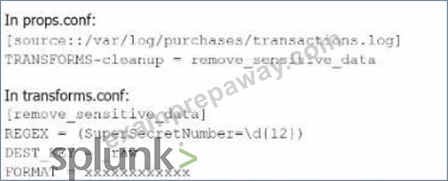
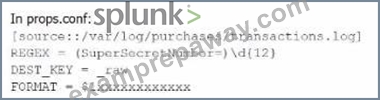
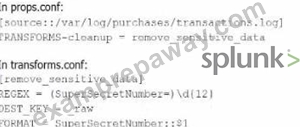
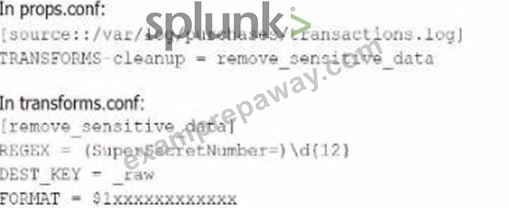
A user has been asked to mask some sensitive data without tampering with the structure of the file /var/log
/purchase/transactions. log that has the following format:
- A.
- B.
- C.
- D.
Answer: D
Explanation:
Option B is the correct approach because it properly uses a TRANSFORMS stanza in props.conf to reference the transforms.conf for removing sensitive data. The transforms stanza in transforms.conf uses a regular expression (REGEX) to locate the sensitive data (in this case, the SuperSecretNumber) and replaces it with a masked version using the FORMAT directive.
In detail:
* props.confrefers to the transforms.conf stanza remove_sensitive_data by setting TRANSFORMS- cleanup = remove_sensitive_data.
* transforms.confdefines the regular expression that matches the sensitive data and specifies how the sensitive data should be replaced in the FORMAT directive.
This approach ensures that sensitive information is masked before indexing without altering the structure of the log files.
Splunk Cloud Reference:For further reference, you can look at Splunk's documentation regarding data masking and transformation through props.conf and transforms.conf.
Source:
* Splunk Docs: Anonymize data
* Splunk Docs: Props.conf and Transforms.conf
NEW QUESTION # 33
What is the name of the attribute that you need to set to true in the [search] stanza of the limits.conf file to enable Data Preview?
- A. show_data_preview
- B. data_preview_enabled
- C. timeline_events_preview
- D. enable_data_preview
Answer: C
NEW QUESTION # 34
Which of the following statements is true about data transformations using SEDCMD?
- A. Can only be used to mask or truncate raw data.
- B. Can be used to manipulate the sourcetype per event.
- C. Configuredin props.conf and transform.conf.
- D. Operates on a REGEX pattern match of the source, sourcetype, or host of an event.
Answer: A
Explanation:
SEDCMD is a directive used within the props.conf file in Splunk to perform inline data transformations.
Specifically, it uses sed-like syntax to modify data as it is being processed.
* A. Can only be used to mask or truncate raw data:This is the correct answer because SEDCMD is typically used to mask sensitive data, such as obscuring personally identifiable information (PII) or truncating parts of data to ensure privacy and compliance with security policies. It is not used for more complex transformations such as changing the sourcetype per event.
* B. Configured in props.conf and transform.conf:Incorrect, SEDCMD is only configured in props.
conf.
* C. Can be used to manipulate the sourcetype per event:Incorrect, SEDCMD does not manipulate the sourcetype.
* D. Operates on a REGEX pattern match of the source, sourcetype, or host of an event:Incorrect, while SEDCMD uses regex for matching patterns in the data, it does not operate on the source, sourcetype, or host specifically.
Splunk Documentation References:
* SEDCMD Usage
* Mask Data with SEDCMD
NEW QUESTION # 35
Which feature of forwarders can prevent data loss in case of network failure or congestion?
- A. Data compression
- B. Configurable buffering
- C. Persistent queues
- D. SSL security
Answer: C
NEW QUESTION # 36
Which configuration file contains the settings for event line breaking and line merging?
- A. transforms.conf
- B. inputs.conf
- C. outputs.conf
- D. props.conf
Answer: D
NEW QUESTION # 37
When monitoring network inputs, there will be times when the forwarder is unable to send data to the indexers. Splunk uses a memory queue and a disk queue. Which setting is used for the disk queue?
- A. queueSize
- B. persistentQueueSize
- C. diskQiioiioiiizo
- D. maxQeueSize
Answer: B
Explanation:
When a forwarder is unable to send data to indexers, it queues the data in memory and optionally on disk. The setting used for the disk queue is persistentQueueSize. This configuration defines the size of the disk queue that stores data temporarily on the forwarder when it cannot immediately forward the data to an indexer.
Splunk Documentation Reference: Configure forwarding and receiving in Splunk
NEW QUESTION # 38
Which type of forwarder is a legacy option that is not recommended for new deployments?
- A. Heavy forwarder
- B. Universal forwarder
- C. Light forwarder
- D. Deployment client
Answer: C
NEW QUESTION # 39
Which configuration file determines how a universal forwarder forwards data to the indexer?
- A. transforms.conf
- B. inputs.conf
- C. outputs.conf
- D. props.conf
Answer: C
NEW QUESTION # 40
In which file can the SH0ULD_LINEMERCE setting be modified?
- A. transforms.conf
- B. inputs.conf
- C. outputs.conf
- D. props.conf
Answer: D
Explanation:
The SHOULD_LINEMERGE setting is used in Splunk to control whether or not multiple lines of an event should be combined into a single event. This setting is configured in the props.conf file, where Splunk handles data parsing and field extraction. Setting SHOULD_LINEMERGE = true merges lines together based on specific rules.
Splunk Documentation Reference: props.conf - SHOULD_LINEMERGE
NEW QUESTION # 41
When using Splunk Universal Forwarders, which of the following is true?
- A. Universal Forwarders must send data to an Intermediate Forwarder.
- B. No more than six Universal Forwarders may connect directly to Splunk Cloud.
- C. There must be one Intermediate Forwarder for every three Universal Forwarders.
- D. Any number of Universal Forwarders may connect directly to Splunk Cloud.
Answer: D
Explanation:
Universal Forwarders can connect directly to Splunk Cloud, and there is no limit on the number of Universal Forwarders that may connect directly to it. This capability allows organizations to scale their data ingestion easily by deploying as many Universal Forwarders as needed without the requirement for intermediate forwarders unless additional data processing, filtering, or load balancing is required.
Splunk Documentation Reference: Forwarding Data to Splunk Cloud
NEW QUESTION # 42
Which feature allows a heavy forwarder to route data to different indexers based on criteria such as source, sourcetype, or host?
- A. Data cloning
- B. Data sampling
- C. Data filtering
- D. Data masking
Answer: A
NEW QUESTION # 43
What is the main difference between events indexes and metrics indexes in Splunk Cloud?
- A. Events indexes store data in compressed form, while metrics indexes store data in uncompressed form.
- B. Events indexes use a highly structured format to handle event-based log data, while metrics indexes impose minimal structure and can accommodate any kind of data.
- C. Events indexes impose minimal structure and can accommodate any kind of data, while metrics indexes use a highly structured format to handle metrics data.
- D. Events indexes store data in uncompressed form, while metrics indexes store data in compressed form.
Answer: C
NEW QUESTION # 44
Which of the following files is used for both search-time and index-time configuration?
- A. macros.conf
- B. savesearch.conf
- C. inputs.conf
- D. props.conf
Answer: D
Explanation:
The props.conf file is a crucial configuration file in Splunk that is used for both search-time and index-time configurations.
* Atindex-time, props.conf is used to define how data should be parsed and indexed, such as timestamp recognition, line breaking, and data transformations.
* Atsearch-time, props.conf is used to configure how data should be searched and interpreted, such as field extractions, lookups, and sourcetypes.
* B. props.confis the correct answer because it is the only file listed that serves both index-time and search-time purposes.
Splunk Documentation References:
* props.conf - configuration for search-time and index-time
NEW QUESTION # 45
Which statement is true about monitor inputs?
- A. ThecrSaltsetting is required.
- B. Monitor inputs are configured in the monitor, conf file.
- C. The ignoreOlderThan option allows files to be ignored based on the file modification time.
- D. Monitor inputs can ignore a file's existing content, indexing new data as it arrives, by configuring the tailProcessor option.
Answer: C
Explanation:
The statement about monitor inputs that is true is that the ignoreOlderThan option allows files to be ignored based on their file modification time. This setting helps prevent Splunk from indexing older data that is not relevant or needed.
Splunk Documentation Reference: Monitor files and directories
NEW QUESTION # 46
When monitoring directories that contain mixed file types, which setting should be omitted from inputs, conf and instead be overridden in propo.conf?
- A. sourcetype
- B. host
- C. source
- D. index
Answer: A
Explanation:
When monitoring directories containing mixed file types, the sourcetype should typically be overridden in props.conf rather than defined in inputs.conf. This is because sourcetype is meant to classify the type of data being ingested, and when dealing with mixed file types, setting a single sourcetype in inputs.conf would not be effective for accurate data classification. Instead, you can use props.conf to define rules that apply different sourcetypes based on the file path, file name patterns, or other criteria. This allows for more granular and accurate assignment of sourcetypes, ensuring the data is properly parsed and indexed according to its type.
Splunk Cloud Reference:For further clarification, refer to Splunk's official documentation on configuring inputs and props, especially the sections discussing monitoring directories and configuring sourcetypes.
Source:
* Splunk Docs: Monitor files and directories
* Splunk Docs: Configure event line breaking and input settings with props.conf
NEW QUESTION # 47
Which of the following is a valid stanza in props. conf?
- A. [host:nyc*]
- B. [host=nyc25]
- C. [sourcetype::linux_secure]
- D. [host::nyc*]
Answer: C
Explanation:
In props.conf, valid stanzas can include source types, hosts, and source specifications. The correct syntax uses colons for specific types, such as source types and hosts, but follows a particular format:
* A. [sourcetype::linux_secure]is the correct answer. This is a valid stanza format for a source type in props.conf. It indicates that the following configurations apply specifically to the linux_secure source type.
* B. [host=nyc25]:Incorrect, the correct format for a host-based stanza uses double colons, not an equal sign.
* C. [host::nyc]:* Incorrect, wildcards are not used in this manner within props.conf.
* D. [host
]:* Incorrect, the correct format requires double colons for host stanzas.
Splunk Documentation References:
* props.conf Specification
NEW QUESTION # 48
......
Truly Beneficial For Your Splunk Exam: https://ucertify.examprepaway.com/Splunk/braindumps.SPLK-1005.ete.file.html