

Verified PMI-RMP exam dumps Q&As with Correct 133 Questions and Answers
PMI PMI-RMP Test Engine PDF - All Free Dumps from ExamPrepAway
Difficulty in writing PMI-RMP Exam
Mostly job holder candidates give a short time to their study and want to pass the exam with good marks. Thereby we have many ways to prepare and practice for exams in a very short time that help the candidates to ready for exams in a very short time without any tension. Candidates can easily prepare PMI PMI-RMP exams from ExamPrepAway because we are providing the best PMI PMI-RMP exam dumps which are verified by our experts. ExamPrepAway has always verified and updated PMI PMI-RMP exam dumps that helps the candidate to prepare his exam with little effort in a very short time. We also provide latest and relevant study guide material which is very useful for a candidate to prepare easily for PMI PMI-RMP exam dumps. Candidate can download and read the latest exam dumps in PDF and VCE format. ExamPrepAway is providing real questions of PMI PMI-RMP exam dumps. We are very fully aware of the importance of student time and money that's why ExamPrepAway give the candidate the most astounding brain exam dumps having all the inquiries answer outlined and verified by our experts.
NEW QUESTION # 34
Don is the project manager of the PFO project for his organization. Don is working with the project team members and two subject matter experts to assess the identified risk events in the project. Which of the following approaches is the best to assess the risk events in the project?
- A. Root cause analysis
- B. Determination of the true cost of the risk event
- C. Probability and Impact Matrix
- D. Interviews or meetings
Answer: D
NEW QUESTION # 35
An external vendor needs to be contracted to provide additional capacity and expertise to a project team to reduce the probability of delays in a project. The contracts department is raising a concern about confidentiality risks not addressed in the proposed contract and missing from the risk register.
What should the risk manager do next?
- A. Implement the risk response plan.
- B. Assess the identified secondary risk.
- C. Communicate the identified residual risk.
- D. Implement the risk contingency plan.
Answer: B
Explanation:
Explanation
According to the PMI Risk Management Professional (PMI-RMP) Examination Content Outline1, a secondary risk is a risk that arises as a direct result of implementing a risk response to a specific risk. In this case, the risk response is to contract an external vendor to provide additional capacity and expertise to the project team. The secondary risk is the confidentiality risk that the contracts department has identified. The risk manager should assess the secondary risk to determine its probability, impact, and priority, and to plan appropriate responses. This is part of the Perform Qualitative Risk Analysis and Plan Risk Responses processes in the PMBOK Guide2. References: 1: PMI Risk Management Professional (PMI-RMP) Examination Content Outline 2: A Guide to the Project Management Body of Knowledge (PMBOK Guide)
- Sixth Edition
NEW QUESTION # 36
You are the project manager of the NHH project for your company. You and the project team have completed the quantitative risk analysis for your project. During this process you create a contingency reserve based on the risk probability-impact matrix as seen in the figure below.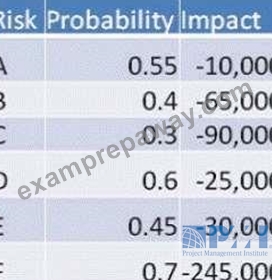
Based on the information in the figure above, what amount would you need to include in your risk contingency fund?
- A. $258,500
- B. -$258,500
- C. $171,500
- D. -$465,000
Answer: A
Explanation:
Explanation/Reference:
NEW QUESTION # 37
Which input could be utilized to perform quantitative risk analysis to reduce uncertainty?
- A. Stakeholder register
- B. Expert judgment
- C. Risk categorization
- D. Organizational process assets
Answer: D
NEW QUESTION # 38
Your organization has a project that is expected to last 20 months but the customer would really like the project completed in 18 months. You have worked on similar projects in the past and believe that you could fast track the project and reach the 18 month deadline. What increases when you fast track a project?
- A. Risks
- B. Communication
- C. Costs
- D. Resources
Answer: A
NEW QUESTION # 39
A complex project that had hundreds of risks is almost done. The project manager is closing the risks as part of the closing process. One team member mentions that there are important documents to be updated.
Which document will need to be updated?
- A. Contingency register
- B. Risk register
- C. Lessons learned
- D. Issue log
Answer: C
Explanation:
Explanation
When closing risks as part of the closing process, it is important to update the lessons learned document. This document captures the knowledge and experience gained during the project and can be valuable for future projects.
Lessons learned is a document that captures the knowledge gained from the project and can help improve the performance of future projects. It is one of the outputs of the project closure process and should include information on the project risks, issues, and responses. Lessons learned can help identify the best practices and lessons to be applied or avoided in similar projects. Updating the lessons learned document is an important part of closing the risks as it can provide valuable insights for risk management. References: PMI, Project Risk Management, 2nd edition, 2019, p. 97-981
NEW QUESTION # 40
Mary is the project manager for the BLB project. She has instructed the project team to assemble, to review the risks. She has included the schedule management plan as an input for the quantitative risk analysis process. Why is the schedule management plan needed for quantitative risk analysis?
- A. Mary will utilize the schedule controls and the nature of the schedule for the quantitative analysis of the schedule.
- B. Mary will schedule when the identified risks are likely to happen and affect the project schedule.
- C. Mary will utilize the schedule controls to determine how risks may be allowed to change the project schedule.
- D. Mary will use the schedule management plan to schedule the risk identification meetings throughout the remaining project.
Answer: A
NEW QUESTION # 41
The risk manager notices that in their workshops, most of the risks identified are threats. What should the risk manager do to increase the number of opportunities identified?
- A. Use the Delphi technique involving experts who have identified opportunities in the past
- B. Conduct a political, economic, sociological, technological, legal, and environmental (PESTLE) analysis
- C. Conduct a strengths, weaknesses, opportunities, and threats (SWOT) analysis
- D. Interview more stakeholders who have a positive mindset
Answer: C
Explanation:
Explanation
A SWOT analysis is a strategic planning tool that helps identify an organization's strengths, weaknesses, opportunities, and threats. By conducting a SWOT analysis, the risk manager can encourage the project team to think more broadly about potential opportunities, leading to a more balanced view of risks and opportunities.
NEW QUESTION # 42
Ruth is the project manager of ISFH project for her company. This project is forty percent complete and it appears that some risk events are going to happen in the project that will have an adverse affect on the project.
Ruth creates a change request regarding the risks. Is this a valid response?
- A. No, change requests should not address risks, only risk response strategies should be issued.
- B. No, change requests should not address pending risks, but only scope changes.
- C. Yes, change requests can ask for additional funds to pay for the risk impact.
- D. Yes, change requests can be recommended for corrective actions for contingency plans.
Answer: D
NEW QUESTION # 43
During a weekly project review meeting, a stakeholder identifies some new risks. When creating risk responses for these newly identified risks, what should the project team do to discover trends and more efficiently manage the responses?
- A. Classify the risk impacts based on their severity.
- B. Determine the root causes.
- C. Identify the risk owners.
- D. List workaround solutions.
Answer: B
NEW QUESTION # 44
CORRECT TEXT
Fill in the blank with an appropriate phrase. The _________ is the risk or danger of an action or an event, a method or a (technical) process that still conceives these dangers even if all theoretically possible safety measures would be applied.
Answer:
Explanation:
residual risk
NEW QUESTION # 45
A risk manager administered a pre-workshop risk survey in preparation for the upcoming workshop. The workshop invitees participated in the survey and submitted many risks encompassing all project phases and risk areas. The risk manager sorts risks by similarities and categories for the workshop.
What should the risk manager do next to visually organize the risks?
- A. Perform the analytical hierarchy process
- B. Develop an affinity diagram
- C. Assign probability and impact
- D. Perform a SWOT analysis
Answer: B
Explanation:
Explanation
An affinity diagram is a tool used to visually organize and group risks or ideas based on their similarities and categories. It helps in structuring the risks for further analysis and discussion. (Reference: PMBOK Guide, 6th Edition, p. 138)
NEW QUESTION # 46
You are the project manager of the GGG project. You have completed the risk identification process for the initial phases of your project. As you begin to document the risk events in the risk register what additional information can you associate with the identified risk events?
- A. Risk cost
- B. Risk schedule
- C. Risk owner
- D. Risk potential responses
Answer: D
NEW QUESTION # 47
Ruth is the project manager of ISFH project for her company. This project is forty percent complete and it appears that some risk events are going to happen in the project that will have an adverse affect on the project. Ruth creates a change request regarding the risks. Is this a valid response?
- A. No, change requests should not address risks, only risk response strategies should be issued.
- B. No, change requests should not address pending risks, but only scope changes.
- C. Yes, change requests can ask for additional funds to pay for the risk impact.
- D. Yes, change requests can be recommended for corrective actions for contingency plans.
Answer: D
NEW QUESTION # 48
Sensitivity analysis is a technique for systematically changing parameters in a model to determine the effects of such changes and is useful for computer modelers for a range of purposes. Which of the following purposes does the sensitivity analysis include? Each correct answer represents a complete solution. Choose all that apply.
- A. Decision making or the development of recommendations for decision makers
- B. Increased understanding or quantification of the system
- C. Estimating the average outcome
- D. Model development
Answer: A,B,D
NEW QUESTION # 49
You are the project manager for the NHQ Project. This project requires that you install 140 copies of design software onto your department's computers. The vendor offers you a twenty percent discount on the software if your company will purchase 150 or more copies of the software. You communicate this offer with other departments in your firm to see if anyone else would need 10 copies of the software to save your project a significant amount of funds. What is this risk response called?
- A. Avoidance
- B. Sharing
- C. Transference
- D. Exploiting
Answer: B
NEW QUESTION # 50
As a part of monitoring and controlling the project, the project manager should update the risk register. The project manager should update the risk register with information on risk reassessment, risk audits, and periodic risk reviews. What other information should the project manager update the risk register with?
- A. Actual outcomes of the project's risks and of the risk responses.
- B. Actual costs and schedule delays of risk events.
- C. Actual outcomes of risk management duties by the project team.
- D. Actual cost of risk events.
Answer: A
NEW QUESTION # 51
You are the project manager of the AMD project for your organization. In this project, you are currently performing quantitative risk analysis. The tool and technique you are using is simulation where the project model is computed many times with the input values chosen at random for each iteration. The goal is to create a probability distribution from the iterations for the project schedule. What technique will you use with this simulation?
- A. Expected Monetary Value
- B. Analogous modeling
- C. Pareto modeling
- D. Monte Carlo Technique
Answer: D
NEW QUESTION # 52
The risk register is developed during the initial phases of a virtualized desktop deployment. The register is reviewed by peers, responses are planned, reviewed again, and risks are prioritized. After project completion, the risk register is reviewed as part of the formal lessons learned process. During the review, itis realized that the risk register was not updated, and many responses were not executed during the deployment.
Which of the following options should have been performed during the execution of the project?
- A. Risk monitoring and control process
- B. Response planning
- C. Risk management process
- D. Risk identification
Answer: A
NEW QUESTION # 53
......
100% Passing Guarantee - Brilliant PMI-RMP Exam Questions PDF: https://ucertify.examprepaway.com/PMI/braindumps.PMI-RMP.ete.file.html